
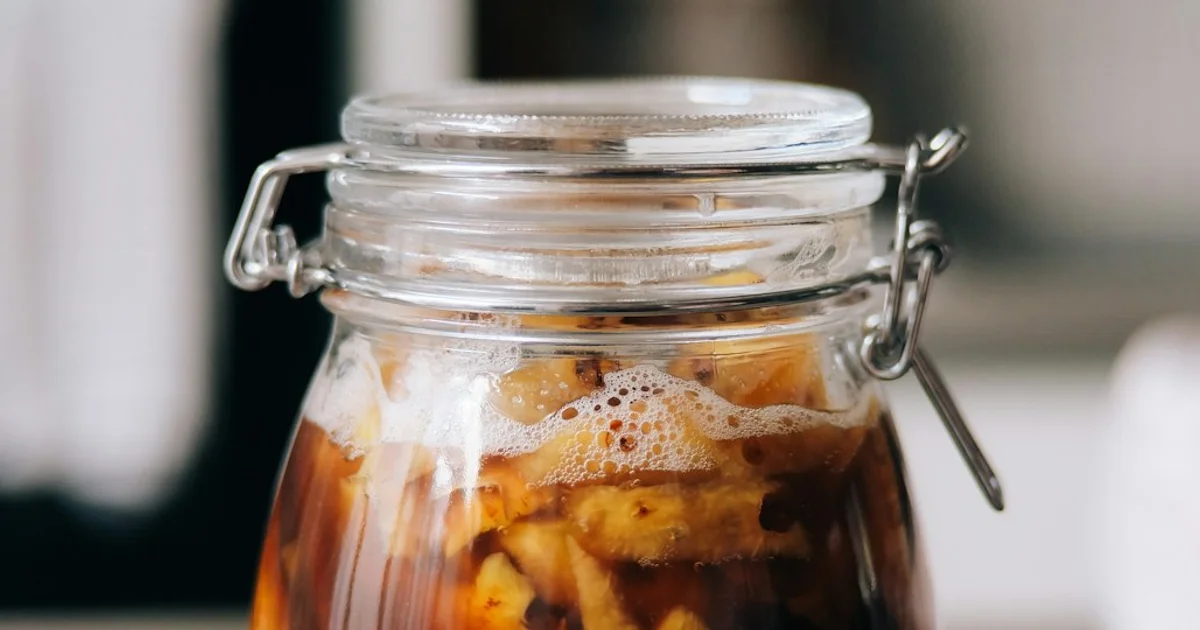
Pineapple skins, unrefined cane sugar, water, a warm kitchen and three days. That recipe is the whole problem. Tepache is a sugar-fed wild fermentation, and sugar-fed wild fermentation makes ethanol whether or not anyone wants it to.
Tepache is Mushbooh. Home-brewed tepache typically ferments to somewhere between 0.5% and 2% alcohol by volume, and keeps climbing the longer it sits. Canned tepache sold as non-alcoholic is held under 0.5% and lands in the same contested place as commercial kombucha. Neither version can be called halal without qualification, and one common street version, tepache topped up with beer, is simply haram.
What tepache actually is
Tepache is a Mexican fermented drink, traditionally made from the peel and core of a pineapple rather than the flesh. The peel goes into a jar with piloncillo (unrefined cane sugar) and water, sometimes with cinnamon or cloves, and is left at room temperature. Wild yeasts and bacteria living on the pineapple skin do the rest.
Two things happen in that jar. Bacteria produce lactic and acetic acid, which gives tepache its sour edge. Yeast converts the sugar to carbon dioxide and ethanol, which gives it fizz and, inevitably, alcohol. There is no way to get the fizz without the ethanol. They are the same reaction.
That makes tepache a closer relative of kombucha and home-brewed ginger beer than of kefir, and the distinction matters for the ruling.
How much alcohol tepache contains
The honest answer is that nobody can tell you from the recipe alone, because the number is set by time and temperature, not ingredients.
| Version | Typical alcohol | What drives it |
|---|---|---|
| Short home ferment (24–48 hours) | Roughly 0.3–0.5% ABV | Yeast has barely started |
| Standard home ferment (2–3 days) | Roughly 0.5–2% ABV | The range most recipes land in |
| Long or warm ferment (4–5 days+) | 2–3% ABV and rising | Sugar still available, yeast still active |
| Deliberately strong recipes | Around 5% ABV | Homebrew recipes marketed as “pineapple beer” |
| Tepache con cerveza | Whatever the beer adds | Beer is poured in to serve; this is not a fermentation by-product |
| Canned “non-alcoholic” tepache (US) | Under 0.5% ABV by law | Short ferment, chilling, and in at least one brand’s case alcohol removal after fermentation |
Three things in that table should shape the reader’s decision.
First, home tepache is not in the trace range. A ferment that reaches 1–2% is a weak alcoholic drink by any ordinary definition. It is not comparable to the 0.01–0.1% in kefir or the sub-0.1% in bread.
Second, the figure is unstable. A jar that measured 0.5% on day two will not measure 0.5% on day four. Any ruling that depends on “it’s only a little” depends on when you stopped.
Third, the canned products are a different question. US rules treat anything under 0.5% ABV as non-alcoholic, and that is where the commercial cans sit. One brand describes a production step that removes the alcohol fermentation produced. We have not seen a lab figure published for any of them, so treat the label claim as the available evidence, not a verified zero.
Why percentage alone does not settle it
HalalCodeCheck’s house position on alcohol in food, set out in our guide to when trace alcohol matters, is that a single percentage threshold is not the Islamic test. Two questions matter more: how the alcohol got there, and whether the drink can intoxicate.
On the first question tepache is on the safer side. Nothing is added. The ethanol is a by-product of natural fermentation, the same mechanism that puts trace alcohol in vinegar, sourdough and kefir. No school treats that mechanism as khamr in itself.
On the second question tepache is on the wrong side, at least when home-brewed. The classical rule across the Sunni schools, from the hadith that what intoxicates in a large amount is forbidden in a small amount, is applied to drinks that are capable of intoxicating in quantity. A 2–3% pineapple ferment can. A 0.05% kefir cannot, however much you drink. That is why kefir is accepted almost universally and tepache is not.
Between those two poles sits the canned product under 0.5%, which is exactly the kombucha debate. Some scholars accept it as incidental fermentation that cannot intoxicate at any realistic volume. Others, particularly those applying a stricter reading of fermented beverages, require below 0.1% or advise avoiding fermented drinks that are brewed to be fizzy at all. Both positions are held by serious scholars. We do not rank them.
Practical guidance
- Home-brewed tepache from a recipe: treat as not halal. The alcohol is real, it is variable, and you have no way to measure it in a kitchen.
- Tepache from a street stall or restaurant: ask whether beer is added. If yes, it is haram. If no, it is still a multi-day wild ferment and falls under the home-brew position above.
- Canned tepache labelled non-alcoholic: Mushbooh, in the same category as commercial kombucha. Readers who accept sub-0.5% kombucha on the incidental-fermentation view will accept this; readers who avoid kombucha should avoid this too.
- Want the flavour without the question: fresh pineapple juice with a pinch of cinnamon and sparkling water gives you the profile with no fermentation at all. Unfermented “tepache-style” soft drinks exist; the label will say pineapple juice and carbonated water, not “fermented”.
Tepache versus kefir, kombucha and vinegar
Readers ask about these together because they are all fermented, and fermented is not one category.
| Drink | Alcohol source | Typical level | Can it intoxicate? | Mainstream position |
|---|---|---|---|---|
| Kefir (commercial) | Incidental, from kefir grains | 0.01–0.1% | No | Accepted |
| Spirit vinegar | Alcohol fully converted to acetic acid | Negligible | No | Accepted by all four schools (istihāla) |
| Kombucha (commercial) | Yeast on sweet tea | Under 0.5% | No at realistic volumes | Contested; we rate Mushbooh |
| Tepache (canned, non-alcoholic) | Yeast on pineapple sugar | Under 0.5% | No at realistic volumes | Contested; we rate Mushbooh |
| Tepache (home-brewed) | Yeast on pineapple sugar | 0.5–2%+, rising | Yes, in quantity | Not halal |
| Tepache con cerveza | Beer added | Beer-level | Yes | Haram |
The pattern is simple once you see it. Milk cultures and finished vinegars stay flat. Sugar-fed yeast drinks climb. The ruling tracks the climb.
Summary
| Question | Answer |
|---|---|
| Is tepache halal? | Mushbooh — a sugar-fed wild ferment that produces real, variable alcohol |
| Home-brewed tepache | Not halal — typically 0.5–2% ABV and rising with every day in the jar |
| Canned “non-alcoholic” tepache | Mushbooh — under 0.5% by law, same contested position as commercial kombucha |
| Tepache with beer added | Haram |
| Is kefir different? | Yes — around 0.01–0.1%, cannot intoxicate, accepted across the schools |
| What resolves the doubt? | A published lab ABV for the specific canned product, or an unfermented pineapple drink instead |
Look up any additive from a fermented-drink label in the E-codes database.
To scan a full ingredient list for halal status in seconds, use the ingredient scanner.
For the wider rules on fermentation, vinegar and flavour carriers, read our guide to trace alcohol in food, and for the drink tepache is most often compared with, our kombucha verdict.
How we reached this verdict
We checked the following sources before publishing this verdict:
- Fermentation science and published recipe measurements — home-style tepache is consistently reported in the 0.5–2% ABV range after two to three days, under 0.5% for very short ferments, and 3% or higher for long or warm ferments; deliberately strong homebrew recipes target around 5%. No source we found reports a stable trace level comparable to kefir.
- Commercial product claims — US canned tepache is marketed as non-alcoholic, which places it under 0.5% ABV under US beverage rules. One brand describes an alcohol-removal step after fermentation. We found no published laboratory ABV for any canned tepache and have not treated the label claim as a verified zero.
- Certification bodies (HMC, HFA, JAKIM, MUI) — no certified tepache product in any register we checked. HMC and HFA do not run a fermented-beverage scheme, so the absence is structural.
- Sunni fatwa scholarship — the four-school rule that a drink which intoxicates in quantity is forbidden in any quantity, applied to brewed drinks; the mainstream acceptance of incidental trace fermentation in kefir, bread and vinegar; and the live disagreement on sub-0.5% kombucha-type drinks, which we have applied unchanged to canned tepache.
- Community discussion (r/islam, reference only) — used to confirm the question readers are actually asking, which is tepache and kefir together. Not cited as evidence.
Madhab note
The four Sunni schools converge on the two ends of this question and diverge in the middle:
- Added beer (tepache con cerveza) — haram across all four schools. Khamr does not become permissible by dilution.
- Incidental trace alcohol from natural fermentation that cannot intoxicate (kefir, bread, vinegar) — accepted across all four schools. Spirit and wine vinegar are the clearest case, through istihāla, which Hanafi and Maliki scholars accept strongly and Shafi’i and Hanbali scholars accept for vinegar specifically.
- A brewed drink that can intoxicate in quantity (home tepache at 1–3%) — forbidden across all four schools on the hadith that what intoxicates in a large amount is haram in a small amount. The classical Hanafi position of Abu Hanifa on certain non-grape nabidh is not applied by contemporary Hanafi bodies (Darul Iftaa Birmingham, AskImam, Mufti Taqi Usmani’s Daruliftaa.com), which treat all intoxicating drinks alike.
- Sub-0.5% commercial fermented drinks — contested within the schools rather than between them. Some Hanafi and Shafi’i scholars accept them as incidental fermentation incapable of intoxicating; stricter readings in every school, and HMC-aligned practice, advise avoidance or a sub-0.1% limit. Where a drink falls here, we mark it Mushbooh and leave the choice to the reader’s own scholar.
Ingredients change. Be first to know.
Brands reformulate without warning. We track every E-code update and halal certification — one short weekly email.
Related Articles
 Ingredient Guides
Is Alcohol in Perfume Halal? Denatured vs Ethyl Alcohol Explained (2026)
There is a genuine scholarly debate on alcohol in perfume — this is not a simple yes or no. This guide explains the Hanafi, Maliki, and Shafi'i positions and lists alcohol-free UK alternatives.
 Ingredient Guides
Is Vegan Food Always Halal? What Vegans Miss About Additives
Vegan food is not automatically halal. This guide explains which food additives appear in vegan products that are still haram or mushbooh for Muslim consumers.
 Shopping Guides
Is Milk of Magnesia Halal? Glycerin and the 0.45% Alcohol
Milk of Magnesia's active ingredient is a mineral. The halal question is the glycerin and the 0.45% alcohol in the flavoured bottles — and one flavour avoids both.