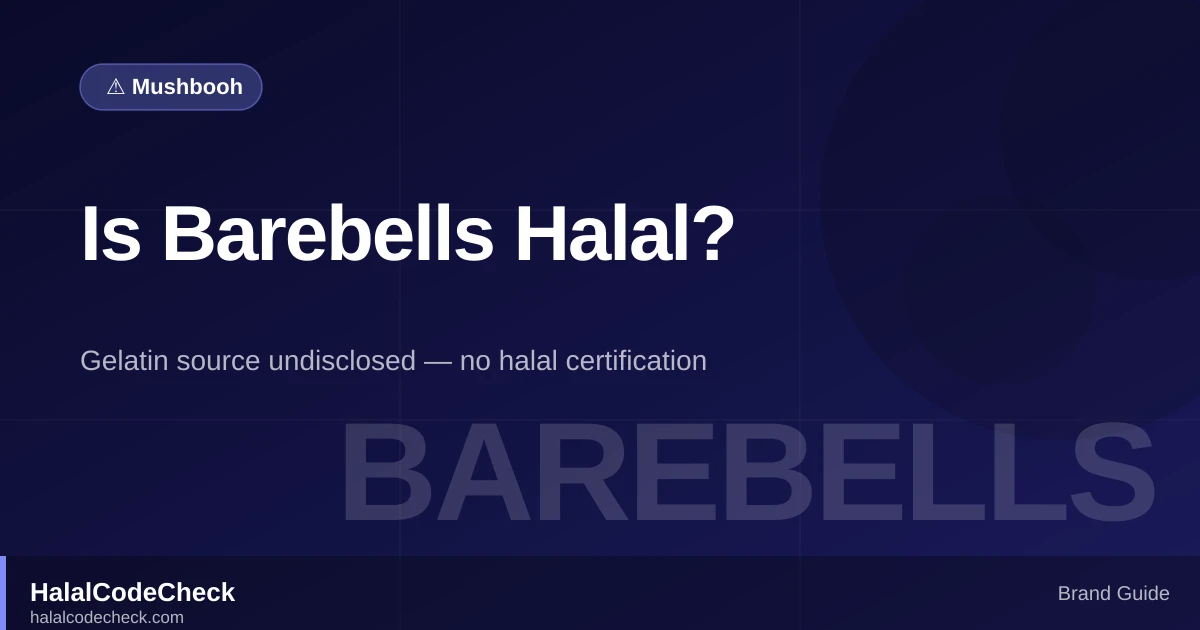
Is Barebells Halal?
ℹ️ Varies by ProductBarebells' own FAQ states that all its milkshakes and, with a few exceptions, its EU-made protein bars are halal-certified, while bars produced in the United States are not. The brand does not name the certifier or publish a certificate, so the EU-made range is 'halal per manufacturer statement' rather than registry-verified. US-made bars are uncertified and the original and soft bars contain bovine collagen of unverified slaughter source — Mushbooh. US retail stock can come from either plant and the listing does not say which.
Country
Sweden
Product Types
Protein bars, Soft bars, Protein milkshakes +1 more
Halal Certification
Manufacturer statement (barebells.com FAQ): milkshakes and most EU-made bars halal-certified, newly launched flavours may await confirmation; US-made bars not certified. Certifier not named; no certificate published. Checked 19 August 2026.
Verified alternatives
Compare more predictable halal-friendly options when a brand varies by product or market.
Is Barebells Halal?
Barebells is a Swedish sports nutrition brand known for its protein bars, soft bars and ready-to-drink milkshakes, sold in UK gyms and supermarkets, across the EU, and in US retail. Whether a Barebells bar is halal depends on where it was made.
Barebells’ own FAQ (checked 19 August 2026) says: “All Barebells Milkshakes are halal-certified, and with a few exceptions, Barebells bars are halal certified” — with two caveats: “newly launched flavours might still await confirmed certification” and “bars produced in the US are not halal certified at this moment.” The US FAQ adds that bars sold in the US “may be produced either in the United States or within the European Union”.
What the brand does not do is name the certifying body or publish a certificate. So the EU-made range sits at “halal per manufacturer statement” — a real statement from the manufacturer, but not one we can check against a certifier’s registry — while US-made bars are uncertified. That split is why this page says Varies.
The ingredient that matters: bovine collagen
The original and soft bars contain bovine collagen (the US FAQ confirms this; plant-based bars contain none). Collagen is cattle hide, and hydrolysed collagen from non-zabiha cattle is not halal under mainstream Sunni rulings — the transformation argument is rejected by, among others, Mufti Taqi Usmani. This is the line that separates the two halves of the range:
- EU-made bars, certified per Barebells — the certification, if it is what the brand says it is, covers the collagen’s slaughter chain. Acceptable on the manufacturer’s statement; ask Barebells for the certifier’s name if you want more.
- US-made bars, uncertified — uncertified bovine collagen is Mushbooh, the same standard we apply to Built Bar and every other collagen bar without a certifier.
- Plant-based bars — no collagen; the question reduces to flavour carriers and facility, as with any uncertified plant bar.
Our collagen guide explains the ruling in full.
Dairy protein
The main protein in the bars and milkshakes is milk protein and whey. Dairy needs no slaughter, so these are halal in themselves; the remaining question is processing and shared facilities, which is exactly what a certification audit covers. For the certified EU range this is answered by the brand’s statement; for US-made bars it is the smaller of the two open questions.
Chocolate coating E-codes
- E476 (PGPR) — castor-oil-based emulsifier whose glycerol can be plant or animal. Plant-sourced and fine in a certified product; Mushbooh when the source is undisclosed.
- E322 (soya lecithin) — plant-derived, halal.
For how Barebells compares with the rest of the shelf, see the 50-bar UK protein bar audit and our US halal protein bars guide.
Product-by-product
| Product | Where made | Halal basis | Verdict |
|---|---|---|---|
| Protein bars (original) — EU-made | Sweden/EU | Certified per Barebells FAQ; certifier unnamed | Halal (manufacturer statement) |
| Soft bars — EU-made | EU | Certified per Barebells FAQ; contain bovine collagen | Halal (manufacturer statement) |
| Protein bars / soft bars — US-made | United States | Not certified; bovine collagen | Mushbooh |
| Plant-based bars | EU / US | Not stated separately; no collagen | Ingredient-suitable, uncertified |
| Milkshakes | EU | ”All Barebells Milkshakes are halal-certified” | Halal (manufacturer statement) |
| Newly launched flavours | — | “might still await confirmed certification” | Check pack |
How to tell which bar you have
- Look for a halal mark on the pack. Barebells does not say which logo to expect; if there is none, treat the bar as uncertified.
- Check the country of manufacture in the small print. “Made in Sweden” / an EU address = covered by the brand’s statement; “Made in USA” = not certified.
- US shoppers: the same flavour on the same shelf can be from either plant. If you require certification, buy the milkshakes (EU-made) or contact Barebells US for batch information.
- Want registry-level certainty? Ask Barebells for the certifier’s name and certificate — the brand has not published it. If Barebells publishes it, this page will be updated.
Summary
| Factor | Details |
|---|---|
| Halal certification | Manufacturer statement: milkshakes + most EU-made bars certified; US-made bars not. Certifier unnamed |
| Key ingredient concern | Bovine collagen in original and soft bars — covered by certification in the EU range, unverified in US-made bars |
| Chocolate coating E-codes | E476 (source via certification), E322 (soya) |
| Verdict | Varies — EU-made and milkshakes: halal per manufacturer statement; US-made bars: Mushbooh |
How we reached this verdict
We checked the following Tier-1 sources (re-checked 19 August 2026):
- Barebells global FAQ (barebells.com/about/faq): milkshakes halal-certified; bars halal-certified “with a few exceptions”; new flavours may await confirmation; “bars produced in the US are not halal certified at this moment.”
- Barebells US FAQ (shop.barebells.com/pages/faq): “At this moment, our bars are not halal certified”; US-sold bars “may be produced either in the United States or within the European Union”; original and soft bars contain bovine collagen, plant-based bars do not.
- HMC / HFA: no listing for Barebells; the brand names no certifier and publishes no certificate, so the EU statement could not be verified against a registry.
- Sunni fatwa on collagen: Mufti Taqi Usmani (Albalagh) — hydrolysed collagen from non-zabiha hide remains impermissible; the istihala argument does not apply.
- Sunni fatwa on source-ambiguous E-codes: IslamQA Hanafi (case 34988); Darul Ifta Birmingham (case 245452) on vegetarian labelling as a plant-source indicator.
Community halal-status sites are not cited here. Several still describe Barebells as “not certified anywhere” — the brand’s own FAQ says otherwise for its EU production — and an earlier version of this page did the same.
Madhab note
- All four Sunni schools accept dairy protein without slaughter certification; the live question in Barebells is the bovine collagen, and all four schools require a halal slaughter chain for it. A manufacturer’s statement of certification satisfies most readers; those following the HMC-strict view will want the certifier named before treating the EU range as Halal.
- US-made bars: uncertified bovine collagen is Mushbooh under all four schools; avoid if you follow the stricter view.
- In Muslim-majority markets where Barebells is sold under local certification (GCC / JAKIM / MUI), the certified SKUs are halal across all four schools.
Key E-Codes in Barebells Products
Do you own or represent Barebells?
Partner with HalalCodeCheck — reach shoppers at the moment they verify your products.
Not sure about a specific Barebells product?
Scan the ingredient label or search by E-code — checks every additive instantly against our database.
Stay informed
Brand formulas change without warning
We update every brand guide when manufacturers reformulate or earn halal certification. Be first to know — one short weekly email.
Related Brands
Burger King
ℹ VariesBurger King UK has a small number of halal-certified restaurants, clearly signposted. US locations are not halal certified. Muslim-majority market locations are fully halal. Always check the specific restaurant before visiting.
Read brand guide
ESN
ℹ VariesESN's production process is not halal certified, but 30 products in its range hold halal certification by variety: selected Designer Whey Protein and Designer Protein Bar flavours, Ultrapure Creatine, the Perfect Base, Carb Loader, Pre and Rec range, and the Vitamin Complex Stack. Everything else is uncertified. Collagen Peptides is beef-derived with no halal-slaughter statement and no certificate — Mushbooh at best.
Read brand guide
Kirkland Signature
ℹ VariesKirkland Signature has no blanket halal certification in the US. The verdict depends entirely on the product: multivitamin gummies (US) contain porcine gelatin and are haram; granola bars use unverified glycerin and natural flavour and are mushbooh; chewy protein bars (peanut butter) carry no gelatin and use vegetable glycerin — rated halal-suitable by IlmHub. Plain nuts, oils, and pantry staples are halal by ingredient.
Read brand guide