
You pick up an orange squash, a packet of biscuits, or a bag of sweets. Flip it over and there it is: E110. Should you put it back?
E110 is one of those additives that needs a second look - not just for halal reasons, but because regulators around the world have disagreed about it for decades. This guide covers the halal status, where it comes from, what countries have restricted it, and how to check it fast.
What Is E110?
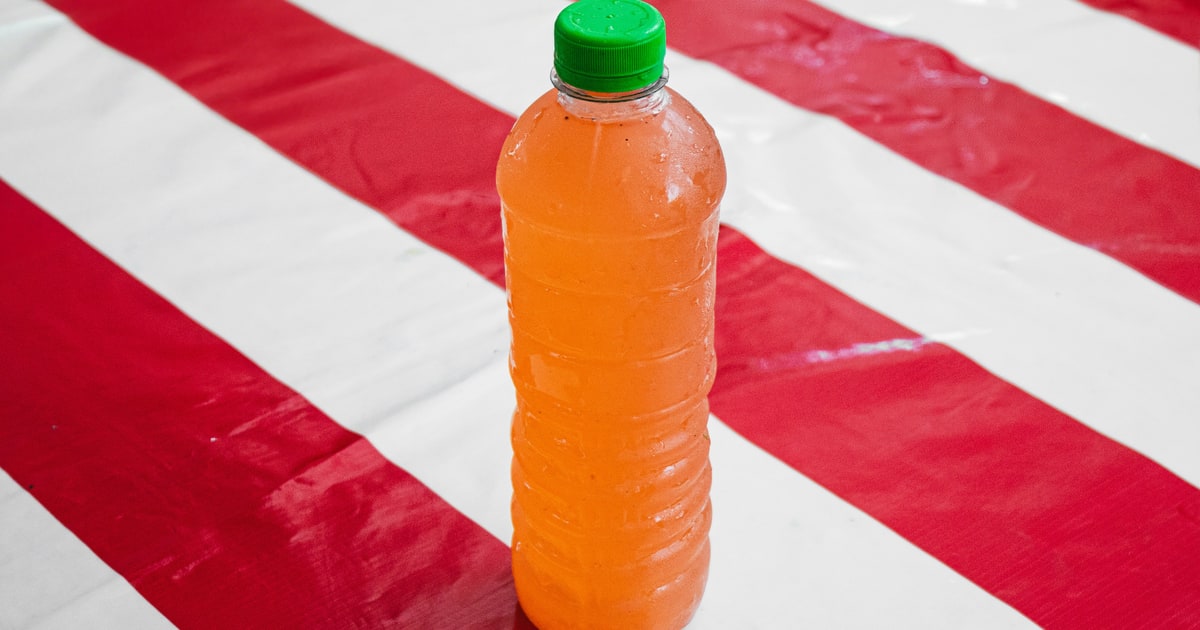
E110 is Sunset Yellow FCF (also called Orange Yellow S). It is a synthetic orange-yellow food dye made from petroleum-derived azo compounds.
You will find it in products that need a yellow or orange colour:
- Orange squash and fizzy drinks
- Marmalade and lemon curd
- Biscuits and crisps
- Sweets and confectionery
- Marzipan and some bakery products
- Smoked fish
On labels it appears as: E110, Sunset Yellow FCF, Orange Yellow S, or FD&C Yellow No. 6 (USA labelling).
Is E110 Halal or Haram?
E110 is classified as Mushbooh - meaning it is conditionally acceptable, not automatically halal.
Here is why it depends:
| Form | Status | Reason |
|---|---|---|
| Dry powder form | Halal | Synthetic origin, no animal source |
| Liquid form (water-based solvent) | Halal | Water is halal solvent |
| Liquid form (alcohol-based solvent) | Haram | Alcohol is impermissible |
E110 itself is a synthetic petroleum-derived compound - there are no animal ingredients involved. But food dyes are often dissolved in a carrier solvent before being added to products, and that solvent may be alcohol.
The practical implication: In most mass-market food products, E110 is used in such small quantities and in dry or water-diluted form that many scholars consider it acceptable. But if a product does not carry halal certification, the solvent question cannot be confirmed from the label alone.
For the full halal ruling with scholarly notes, see E110 in the E-codes database.
Is E110 Banned in Any Countries?
This is the question that brings a lot of people to this page. The answer is nuanced:
European Union - Mandatory Warning Label
E110 is not banned in the EU, but since 2010 any product containing it must carry this warning on the label:
“may have an adverse effect on activity and attention in children”
This requirement came from a 2007 study commissioned by the UK Food Standards Agency (the “Southampton study”), which found a link between a mix of six artificial food colours - including Sunset Yellow - and increased hyperactivity in children.
The EU did not ban E110, but the mandatory warning has led many European manufacturers to voluntarily reformulate their products to remove it.
United Kingdom - Same Warning Applies
Post-Brexit, the UK retained the EU warning requirement. Products sold in the UK containing E110 must carry the same hyperactivity warning.
USA - Approved as FD&C Yellow No. 6
In the USA, E110 is approved by the FDA under the name FD&C Yellow No. 6. There is no ban and no mandatory hyperactivity warning in the USA, though the FDA has acknowledged the Southampton study findings.
Norway and Austria
Norway and Austria have historically applied stricter approaches to synthetic azo food dyes and have restricted or discouraged their use in some product categories, though outright bans depend on the specific product type.
Australia and New Zealand
E110 is permitted in Australia and New Zealand under the name Colour 110 in the Food Standards Code. It is widely used in products sold in those markets.
What Is the Safe Daily Limit for E110?
The European Food Safety Authority (EFSA) sets the Acceptable Daily Intake (ADI) for E110 at 4 mg/kg body weight per day.
For reference:
- An adult weighing 70 kg: safe up to 280 mg/day
- A child weighing 25 kg: safe up to 100 mg/day
Actual exposure through food is typically far below these limits for most people. The concern for children is not toxicity but the hyperactivity link - a different mechanism.
E110 vs Similar Yellow Food Dyes
E110 is one of several synthetic yellow/orange dyes used in food. Here is how it compares to the ones you will most often see together:
| E-code | Name | Colour | EU Warning | Halal Status |
|---|---|---|---|---|
| E102 | Tartrazine | Yellow | Yes | Mushbooh |
| E110 | Sunset Yellow FCF | Orange-Yellow | Yes | Mushbooh |
| E104 | Quinoline Yellow | Yellow | Yes | Mushbooh |
| E122 | Carmoisine | Red | Yes | Mushbooh |
All six dyes in the Southampton study carry the EU hyperactivity warning. All are Mushbooh for halal purposes for the same reason: the solvent question.
How to Verify E110 When You Shop
Step 1 - Look for halal certification. A credible halal mark (HMC, HFA, IFANCA) means the manufacturer has confirmed solvent and ingredient sources.
Step 2 - Check the label format. “E110” or “Sunset Yellow FCF” both refer to the same additive. If it says “natural colour” it is not E110.
Step 3 - Use the database. Search E110 in our E-codes database for instant status, or scan the ingredient list to check every additive at once.
Step 4 - Contact the manufacturer. A short email asking “Is E110 in this product in dry powder or dissolved form, and if dissolved, what solvent is used?” usually gets a clear answer from technical teams.
Common Questions About E110
Is E110 always haram?
No. E110 is Mushbooh, not automatically haram. The dye itself has no animal origin. The concern is the carrier solvent - if it is water-based, E110 is halal. Most scholars hold that synthetic dyes like E110 are permissible as long as the solvent is halal.
Can children eat E110?
This is a health question separate from halal. The EU mandatory warning exists because of a potential link to hyperactivity in children. Many parents avoid the six Southampton dyes for children regardless of halal status. See the label warning - if the product contains E110, it must state the hyperactivity advisory in EU and UK markets.
Is E110 vegetarian and vegan?
Yes. E110 is petroleum-derived and contains no animal products. It is suitable for vegetarians and vegans on ingredient grounds.
Is natural Sunset Yellow different from E110?
Some products use “natural yellow/orange” colours such as beta-carotene (E160a) or annatto instead of E110. These carry no hyperactivity warning, though E160a is also Mushbooh (some formulations add gelatin as a carrier). If a label says “natural colour” or lists a specific plant source, it is not E110.
What To Do Next
E110 is a verify first additive - the same approach as any Mushbooh code.
- Check E110’s full ruling - halal status, scholar notes, common foods
- Scan any product label - get E110 status alongside every other additive in seconds
- Browse related dyes - E102 Tartrazine, E104 Quinoline Yellow
If you want to understand the full E-code system, start with the E-Codes Halal Guide - it covers all colour codes and how the halal rules work across each category.
Ingredients change. Be first to know.
Brands reformulate without warning. We track every E-code update and halal certification — one short weekly email.
Related Articles
 E-Codes & Additives
 Is L-Cysteine (E920) Halal? The Bread Additive With a Hidden Source
L-cysteine (E920) in bread can be derived from human hair, duck feathers, or synthetic production. Human hair source is haram. Synthetic E920 is halal. Here's how to tell.
 E-Codes & Additives
 Is Shellac (E904) Halal? The Insect-Derived Glazing Agent
Shellac (E904) is a resin secreted by lac insects used to coat confectionery and apples. Most scholars consider it haram. Here's what to look for on labels.
 E-Codes & Additives
 Is Carrageenan (E407) Halal? The Seaweed Thickener Explained
Carrageenan (E407) is derived from red seaweed and is halal — no animal ingredients, no haram processing. Learn where it is used and why it is safe for Muslim shoppers.