
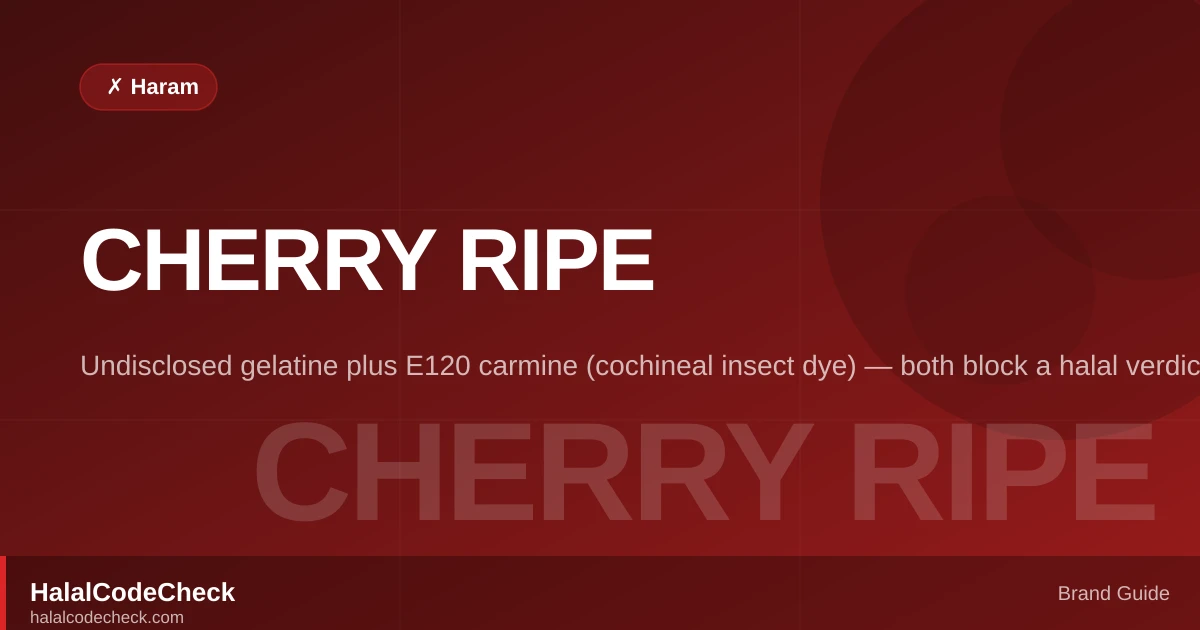
Is Cherry Ripe Halal?
❌ HaramCherry Ripe's ingredient list carries two separate halal concerns: gelatine with no disclosed source or slaughter method, and Colour 120 (cochineal/carmine) — a red colouring derived from crushed cochineal insects, which the majority of Islamic scholars rule Haram outright. Either ingredient alone would be enough to block the verdict; together they make the bar clearly Haram, regardless of unverified claims circulating online about HCAA certification.
Country
Australia
Product Types
Chocolate bar
Halal Certification
No confirmed halal certification. Some online sources claim HCAA (Halal Certification Authority Australia) certification, but this is not verifiable on Cadbury Australia's own product information, and the ingredient list itself contains E120.
Halal-certified alternatives
Compare halal-certified options if you are looking to replace this brand.
Is Cherry Ripe Halal?
Cherry Ripe is Cadbury Australia’s cherry-and-coconut bar under dark chocolate, and one of the country’s most recognisable confectionery names since 1924. Cadbury globally sits at Mushbooh on this site — undisclosed emulsifier sourcing is the usual issue. Cherry Ripe is worse than that baseline: its ingredient list names gelatine with no disclosed source, and Colour 120, which is cochineal — a red dye extracted from crushed female cochineal insects.
Neither ingredient gets the benefit of the doubt. Gelatine without a confirmed halal-slaughtered source is treated as impermissible under mainstream Sunni rulings, the same standard applied elsewhere on this site to Coppenrath & Wiese and Wagon Wheels. E120 is more clear-cut still — the majority of Islamic scholars, including HMC and HFA, classify cochineal-derived colourings as Haram because they come from an insect not permissible to consume, the same finding documented on our Bassett’s brand page for Liquorice Allsorts. Either finding alone is enough to fail the product; Cherry Ripe has both.
You may see claims online that Cherry Ripe holds HCAA (Halal Certification Authority Australia) certification. We could not verify this on Cadbury Australia’s own materials, and it would be inconsistent with an ingredient list that still names cochineal — a certifying body wouldn’t typically pass a product containing E120. Treat that certification claim as unconfirmed rather than relying on it.
Key E-Codes in Cherry Ripe
| E-code | Name | Status | Notes |
|---|---|---|---|
| E120 | Cochineal / Carmine | Haram | Insect-derived red colouring, present in the standard Australian formulation |
| E441 | Gelatine | Haram (as used here) | Source and slaughter method not disclosed on the Australian pack |
Summary
| Factor | Details |
|---|---|
| Halal certification | Unconfirmed — claimed by some third-party sources, not verifiable on official packaging or Cadbury materials |
| Gelatine | Present, source undisclosed |
| E120 (cochineal) | Present |
| Verdict | Haram |
How we reached this verdict
We checked the following Tier-1 sources before publishing this verdict:
- Halal certification bodies (HMC, HFA, JAKIM, MUI, HCAA): no verifiable current certification listing found for Cherry Ripe; online claims of HCAA certification could not be corroborated against Cadbury Australia’s own product information.
- Manufacturer/product ingredient lists: the standard Australian ingredient panel confirms gelatine (source undisclosed) and Colour 120 (cochineal).
- Sunni fatwa scholarship across the four madhabs: cochineal/carmine (E120) is ruled Haram by the majority of scholars across Hanafi, Maliki, Shafi’i, and Hanbali schools as an insect-derived ingredient; gelatine from unconfirmed slaughter is treated as impermissible under the dominant Hanafi position shared by Maliki and Shafi’i cautionary rulings.
Madhab note
The four Sunni madhabs broadly converge on the rules applied in this guide:
- Cochineal / carmine (E120) — Haram under the majority position across all four madhabs, as it derives from an insect not permissible to consume; a small minority of scholars permit insect-derived dyes, but this is not the mainstream position we publish here.
- Gelatine from unconfirmed slaughter — impermissible per the dominant Hanafi position and shared by Maliki and Shafi’i cautionary rulings; a minority of contemporary scholars accept istihāla (transformation) for gelatine, which would not change the outcome here given the additional E120 concern.
If your madhab differs on either ruling, consult a competent scholar in your tradition for a binding ruling.
Key E-Codes in Cherry Ripe Products
Not sure about a specific Cherry Ripe product?
Scan the ingredient label or search by E-code — checks every additive instantly against our database.
Stay informed
Brand formulas change without warning
We update every brand guide when manufacturers reformulate or earn halal certification. Be first to know — one short weekly email.
Related Brands
Bounty
⚠ MushboohBounty UK contains E471 (mono and diglycerides) with an undisclosed plant or animal source. Mars holds no UK halal certification. Mushbooh — same position as Twix, Snickers, and other Mars UK confectionery.
Read brand guide
Milka
⚠ MushboohMilka chocolate (Mondelez International) contains E476 (PGPR — polyglycerol polyricinoleate) whose source is not disclosed for UK and European products. Mondelez holds no halal certification for Milka in the UK. The brand is Mushbooh for UK Muslim consumers until the emulsifier source is confirmed or certification is obtained.
Read brand guide
Toblerone
⚠ MushboohToblerone contains honey (halal) and E471 (source unconfirmed). Mondelez International holds no UK halal certification. Without certification, Toblerone is Mushbooh.
Read brand guide