
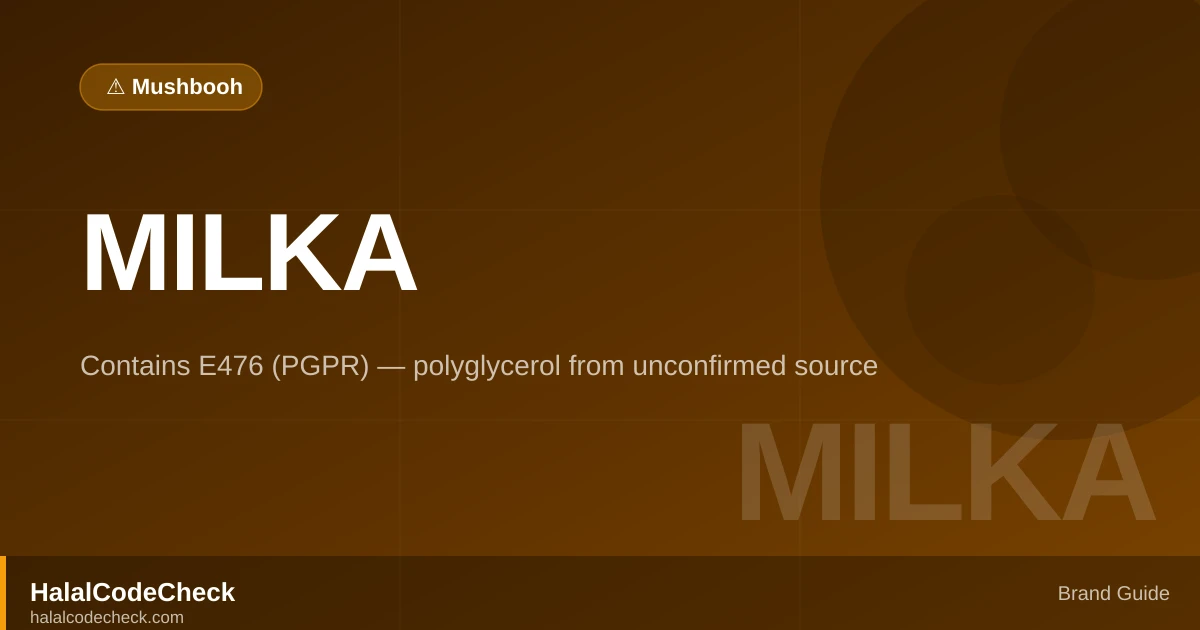
Is Milka Halal?
⚠️ MushboohMilka chocolate (Mondelez International) contains E476 (PGPR — polyglycerol polyricinoleate) whose source is not disclosed for UK and European products. Mondelez holds no halal certification for Milka in the UK. The brand is Mushbooh for UK Muslim consumers until the emulsifier source is confirmed or certification is obtained.
Country
United Kingdom
Product Types
Milk chocolate bars, Alpine milk chocolate, Chocolate with fillings +2 more
Halal Certification
No halal certification in the UK or Europe.
Safer alternatives
Browse halal-friendly substitutes while this brand remains uncertain.
Is Milka Chocolate Halal?
Milka is an Alpine milk chocolate brand produced by Mondelez International (formerly Kraft Foods). Iconic for its lilac packaging and cow imagery, Milka is one of Europe’s best-selling chocolate brands. Like many European chocolate brands, Milka uses emulsifiers to achieve its smooth, creamy texture — and it is these emulsifiers that create a halal concern.
Standard Milka chocolate contains E476 (PGPR, polyglycerol polyricinoleate), an emulsifier used to control chocolate viscosity and reduce cocoa butter content. E476 can be derived from plant oils (castor oil — halal) or from animal-derived glycerol. Mondelez does not disclose the specific source of E476 used in Milka UK production, and no halal certification is held.
E476 — The Core Concern
E476 (PGPR) is synthesised through a multi-step chemical process involving glycerol and fatty acids. The fatty acid component is typically from castor beans (plant — halal), but the glycerol can be a by-product of soap manufacturing (which uses animal fats) or derived from plant oils. Without a halal audit confirming plant-only sourcing, E476 from an unknown source is Mushbooh.
In practice, major European chocolate manufacturers (Mondelez included) are believed to use plant-derived sources for E476 — it is cheaper and more consistent. However, belief is not verification, and without certification, the product remains Mushbooh.
E322 (Lecithin) in Milka
Milka typically lists “soya lecithin” (E322) — plant-derived and halal. This is a positive indicator but does not address the E476 concern.
Milka Fillings and Variants
Milka produces a wide range of filled chocolates — caramel, strawberry yogurt, oreo, milka & lu biscuit, and many others. Each filling introduces additional ingredients. Caramel variants may contain additional E471. Yogurt fillings contain dairy, which is halal. Always check the label of specific Milka variants as the E-code profile can vary.
Summary
| Factor | Details |
|---|---|
| Halal certification (UK/EU) | None |
| Key concern | E476 (PGPR) — source not disclosed |
| E322 (soya lecithin) | Halal |
| Verdict | Mushbooh — emulsifier source unverified |
| Recommendation | Choose a halal-certified chocolate alternative |
Individual Milka Products
All products →| Product | Verdict |
|---|---|
| Alpine Milk Chocolate | ⚠️ Mushbooh |
| Milka Oreo Chocolate Bar | ⚠️ Mushbooh |
| Milka Whole Nut | ⚠️ Mushbooh |
| Milka Oreo Chocolate Bar | ⚠️ Mushbooh |
Key E-Codes in Milka Products
Not sure about a specific Milka product?
Scan the ingredient label or search by E-code — checks every additive instantly against our database.
Stay informed
Brand formulas change without warning
We update every brand guide when manufacturers reformulate or earn halal certification. Be first to know — one short weekly email.
Related Brands
Ülker
✓ HalalÜlker is halal for its core product lines manufactured in Turkey. As Turkey's leading food conglomerate, halal compliance is foundational to Ülker's production. Always verify local label when purchasing outside Turkey.
Read brand guide
Ritter Sport
⚠ MushboohRitter Sport (Alfred Ritter GmbH, Germany) is Mushbooh. Some variants contain E476 (PGPR) and E442 (ammonium phosphatides) — emulsifiers that can be animal- or plant-derived. The source is not disclosed for UK/European products and no halal certification is held. Until source confirmation or certification, Ritter Sport is Mushbooh for UK halal consumers.
Read brand guide
Cadbury
⚠ MushboohCadbury UK holds no halal certification. Products contain E442 (ammonium phosphatides) and E476 (PGPR) - emulsifiers that can be derived from animal fat. Until Cadbury discloses the source or obtains certification, UK products are Mushbooh. Cadbury products sold in Pakistan, Malaysia, and Egypt are manufactured locally and may hold regional halal certification.
Read brand guide