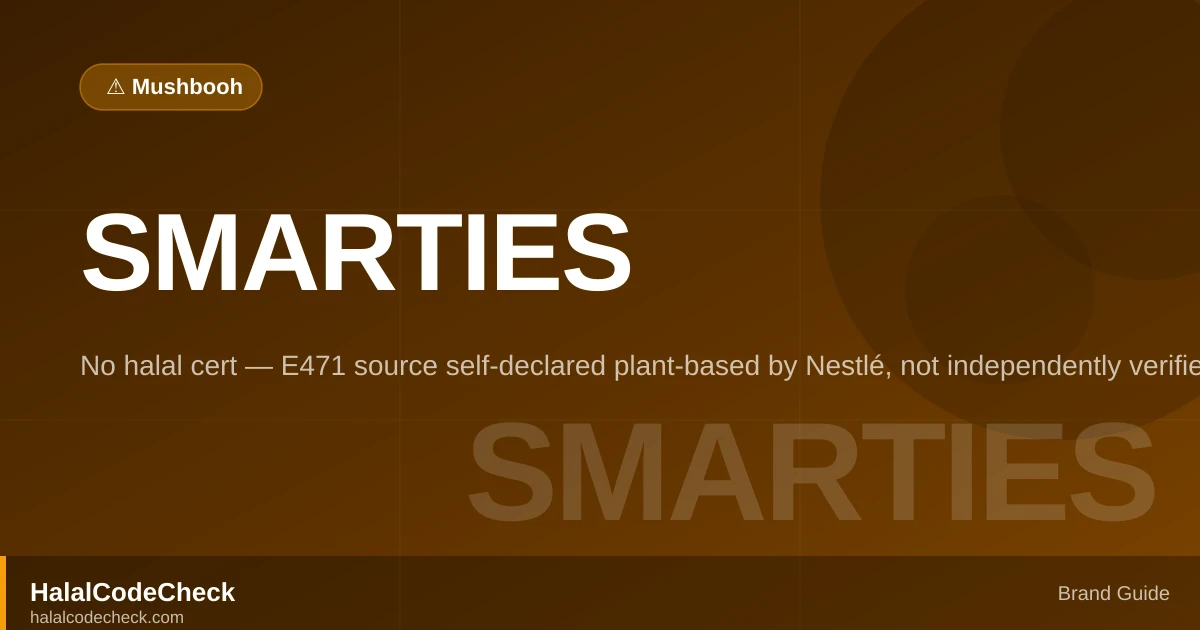
Is Smarties Halal?
⚠️ MushboohSmarties UK are vegetarian-certified but not halal-certified. Nestlé self-declares that E471 in Smarties is of vegetable origin, but this has not been independently audited by HMC, HFA, or MCB. No gelatin is used. Plant-based colours replaced artificial dyes in 2006. For Muslims who require a recognised halal stamp, standard UK Smarties are Mushbooh. Smarties manufactured for Malaysia and the Middle East may carry regional Nestlé halal certification.
Country
United Kingdom
Product Types
Candy-coated chocolate beans, Mini Smarties tubes, Easter eggs +1 more
Halal Certification
No HMC, HFA, or MCB halal certification for UK market. Vegetarian Society certified. Nestlé self-declares E471 source as plant-based for vegetarian-labelled products.
Safer alternatives
Browse halal-friendly substitutes while this brand remains uncertain.
Are Smarties Halal?
Smarties are one of the UK’s most popular children’s sweets — but they do not carry halal certification from any recognised UK Islamic body.
Nestlé UK holds no HMC (Halal Monitoring Committee) or HFA (Halal Food Authority) certification for Smarties sold in the UK. The Vegetarian Society logo appears on standard Smarties packs, but vegetarian certification is not the same as halal certification.
What’s In Smarties?
No gelatin — this is the good news. Nestlé confirmed that standard UK Smarties do not contain gelatin in their shell or filling.
Colours — Nestlé reformulated UK Smarties in 2006, removing all artificial colours. Current colours are derived from plant sources: spirulina blue, carrot/radish/red cabbage extract, paprika, and annatto. No carmine (E120, insect-derived) is used in standard Smarties.
E471 (mono- and diglycerides of fatty acids) — this is the main concern. E471 can be sourced from animal fat or vegetable oil. Nestlé states that in products carrying the Vegetarian Society logo, E471 is from vegetable or synthetic origin — but this is a manufacturer self-declaration, not independently verified by a halal certification body.
The Verification Gap
The Vegetarian Society audits products for vegetarian compliance. It does not audit for halal compliance, nor does it verify that production lines are free from cross-contamination with haram products.
Nestlé has been contacted by consumers asking whether Smarties are on their “halal list” — the company confirmed they are not.
For Muslims who follow HMC or HFA-guided purchasing, the absence of independent halal certification means Smarties are Mushbooh (doubtful).
Special Editions and Gummy Variants
Always check the label for limited edition Smarties products. Some novelty or gummy variants may contain gelatin. The vegetarian logo only applies to the standard Smarties bean format.
Smarties by Region
| Market | Status |
|---|---|
| UK (standard) | Mushbooh — vegetarian certified, no halal certification |
| Malaysia / Middle East | May carry regional Nestlé halal certification — check packaging |
| Other markets | Check local certification and ingredient list |
Summary
| Factor | Details |
|---|---|
| Halal certification | None (UK market) |
| Gelatin | Not used in standard Smarties |
| E471 | Present — source self-declared plant-based, not independently verified |
| Colours | Plant-based (no carmine) |
| Verdict | Mushbooh — acceptable for lenient consumers, not for those requiring halal certification |
For broader Nestlé product coverage (KitKat, Quality Street, Aero), see our Nestlé brand guide.
Key E-Codes in Smarties Products
Not sure about a specific Smarties product?
Scan the ingredient label or search by E-code — checks every additive instantly against our database.
Stay informed
Brand formulas change without warning
We update every brand guide when manufacturers reformulate or earn halal certification. Be first to know — one short weekly email.
Related Brands
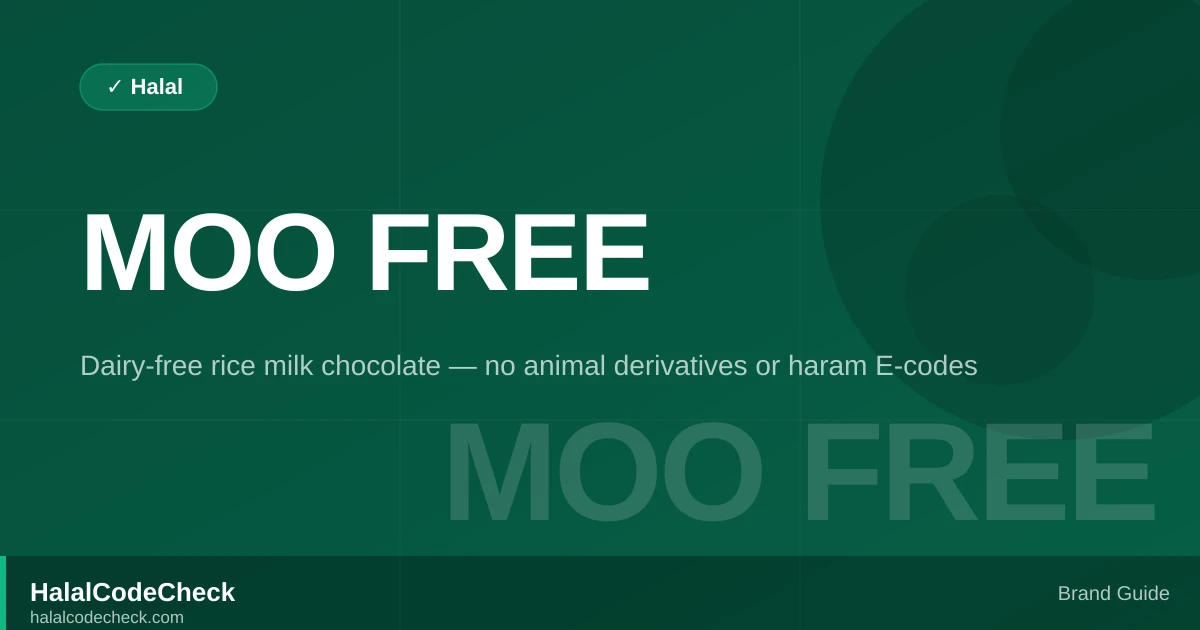
Moo Free
✓ HalalMoo Free is a UK free-from chocolate brand made with rice milk instead of dairy. All Moo Free products are dairy-free, gluten-free, soya-free, and free from animal-derived additives. No E441 (gelatine), E120 (cochineal), or undisclosed animal emulsifiers. Suitable for halal consumers, though the brand has not pursued formal halal certification.
Read brand guide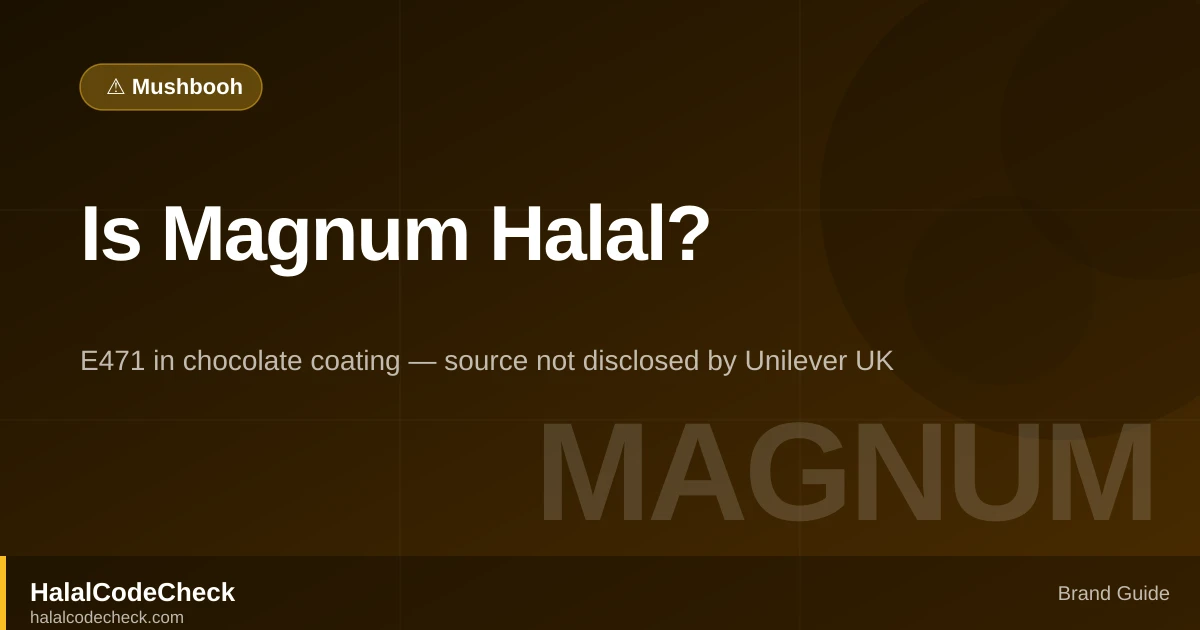
Magnum
⚠ MushboohMagnum ice cream bars (Unilever) are Mushbooh in the UK and EU. The chocolate coating contains E471 (mono and diglycerides of fatty acids) from an undisclosed source. No halal certification applies to UK or European Magnum products. Halal-certified Magnum is produced for Malaysia (JAKIM), Indonesia (MUI), and some Middle Eastern markets.
Read brand guide
Tirol
⚠ MushboohTirol Choco (Japan) produces dozens of individually-wrapped chocolate varieties, some of which contain gelatine from an undisclosed source. No Tirol products carry halal certification. Without declared halal-slaughter gelatine or third-party certification, Tirol is Mushbooh for Muslim consumers.
Read brand guide