
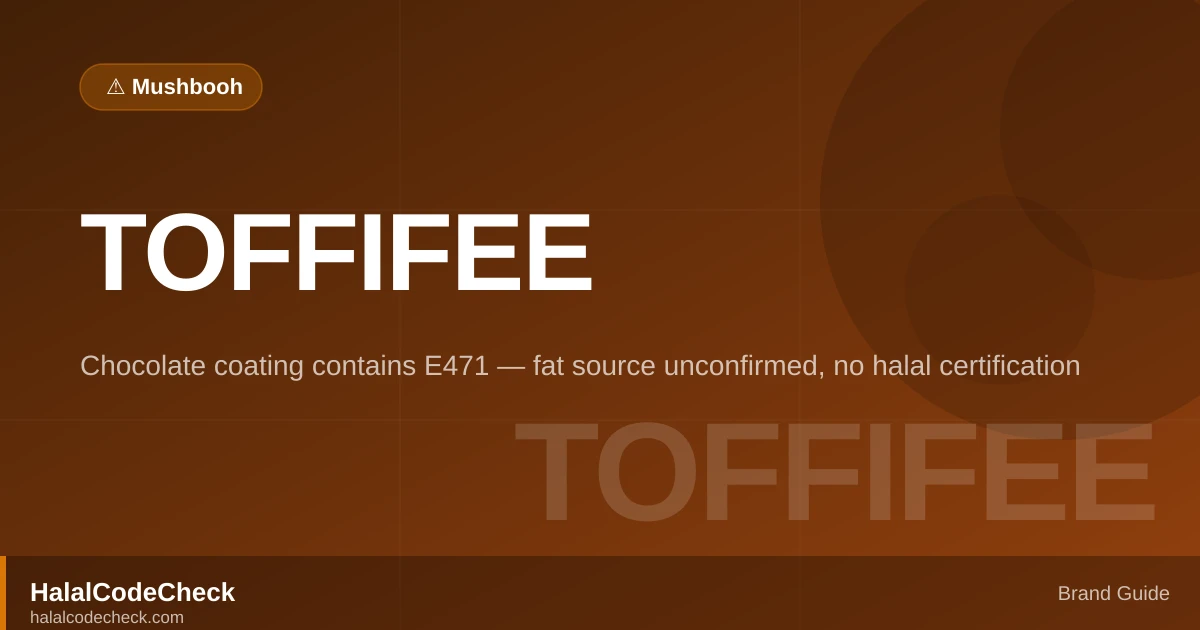
Is Toffifee Halal?
⚠️ MushboohToffifee (made by Storck, Germany) contains E471 in the chocolate and cream filling whose animal or vegetable fat source is not declared. There is no halal certification for any Toffifee products. The hazelnut and caramel components are permissible, but the undisclosed emulsifiers make Toffifee Mushbooh overall.
Country
Germany
Product Types
Boxed chocolates, Caramel and hazelnut cups, Seasonal gift boxes
Halal Certification
No halal certification. Storck (Germany) has not published E471 source declarations for Toffifee.
Safer alternatives
Browse halal-friendly substitutes while this brand remains uncertain.
Is Toffifee Halal?
Toffifee is a boxed chocolate confection made by August Storck KG — a German family-owned confectionery company also responsible for brands such as Werther’s Original and Merci. Each Toffifee piece consists of a whole hazelnut set in a caramel cup, with a creamy chocolate filling and a chocolate coating on top.
Toffifee is extremely popular in Germany, across continental Europe, and in South Asian diaspora communities — which is why it appears in our search queries from Pakistani users. Unfortunately, it is not halal-certified and contains emulsifiers whose source is not disclosed.
What Makes Toffifee Mushbooh?
The main concern is E471 (mono and diglycerides of fatty acids) in the chocolate coating and cream filling. E471 is a common emulsifier in chocolate confectionery that can be derived from:
- Vegetable fats (palm, sunflower, rapeseed) — halal
- Animal fats (including pork fat) — haram
- A mixture of both
Storck does not publish ingredient sourcing information for E471 in Toffifee, and the product carries no halal certification from HMC, HFA, or any European halal body.
E322 (lecithin) is also used as an emulsifier. Lecithin is most commonly soya-derived (halal) or egg-derived. Where the label states “soya lecithin,” this is halal. Plain “lecithin” is more ambiguous but typically soya-derived in modern chocolate products.
E476 (polyglycerol polyricinoleate / PGPR) may appear in some Toffifee formulations. Like E471, its fatty acid component can be animal-derived. Storck does not specify.
Ingredient Breakdown
| Ingredient | Halal Concern |
|---|---|
| Whole hazelnut | No concern — halal |
| Caramel (sugar, glucose, butter, cream) | Dairy from cows — halal |
| Chocolate coating | Contains E471 — source unconfirmed → Mushbooh |
| Cream chocolate filling | Contains E471 — source unconfirmed → Mushbooh |
| E322 (lecithin) | Usually soya — typically halal, check label |
| E476 | Fatty acid source unconfirmed → Mushbooh |
Is Toffifee Available in Halal-Certified Form?
No. Storck does not manufacture a halal-certified variant of Toffifee for any market. Unlike some global brands that produce regionally-certified products for Muslim-majority countries, Toffifee has not pursued halal certification.
Halal Alternatives
If you want a similar hazelnut chocolate experience with halal certification:
- Ferrero Rocher — check our Ferrero brand guide for their current certification status
- Ulker Hazelnut Chocolate — Turkish brand, halal-certified, widely available in UK halal shops
- Kras Bajadera — Croatian hazelnut confection, no E471 issues
- Local halal confectionery shops — often stock Turkish and Arab hazelnut chocolates with full certification
Summary
| Factor | Details |
|---|---|
| E471 | Present — fat source undisclosed |
| E322 (lecithin) | Usually soya — check label |
| E476 | May be present — source unconfirmed |
| Gelatine | Not present in standard Toffifee |
| Alcohol | Not present |
| Halal certification | None |
| Verdict | Mushbooh — emulsifier sources unverified |
Toffifee is a popular treat but cannot be confirmed as halal. Pakistani and German diaspora consumers asking about it should opt for a certified Turkish hazelnut chocolate alternative.
Key E-Codes in Toffifee Products
Not sure about a specific Toffifee product?
Scan the ingredient label or search by E-code — checks every additive instantly against our database.
Stay informed
Brand formulas change without warning
We update every brand guide when manufacturers reformulate or earn halal certification. Be first to know — one short weekly email.
Related Brands
Quality Street
⚠ MushboohQuality Street contains E471 (mono- and diglycerides of fatty acids) in most pieces, with the source not disclosed by Nestlé for UK production. The current UK ingredient lists do not show E120 (cochineal) or gelatin. There is no UK halal certification. Under the Sunni mainstream rule that undisclosed E471 source = avoid (per IslamQA Hanafi and Darul Iftaa Trinidad), Quality Street is Mushbooh.
Read brand guide
Reese's
⚠ MushboohReese's Peanut Butter Cups, Pieces, Thins, and Big Cups are manufactured by The Hershey Company and carry no halal certification in the US, UK, Canada, or Australia. There are no confirmed pork-derived ingredients or gelatine. The emulsifier is E322 (soya lecithin — plant-based and halal). The main concern is the absence of a halal audit covering dairy sourcing and manufacturing processes. TBHQ antioxidant is synthetic with no animal concern. Overall verdict: Mushbooh — no overt haram ingredients, but no independent certification.
Read brand guide
Tirol
⚠ MushboohTirol Choco (Japan) produces dozens of individually-wrapped chocolate varieties, some of which contain gelatine from an undisclosed source. No Tirol products carry halal certification. Without declared halal-slaughter gelatine or third-party certification, Tirol is Mushbooh for Muslim consumers.
Read brand guide