
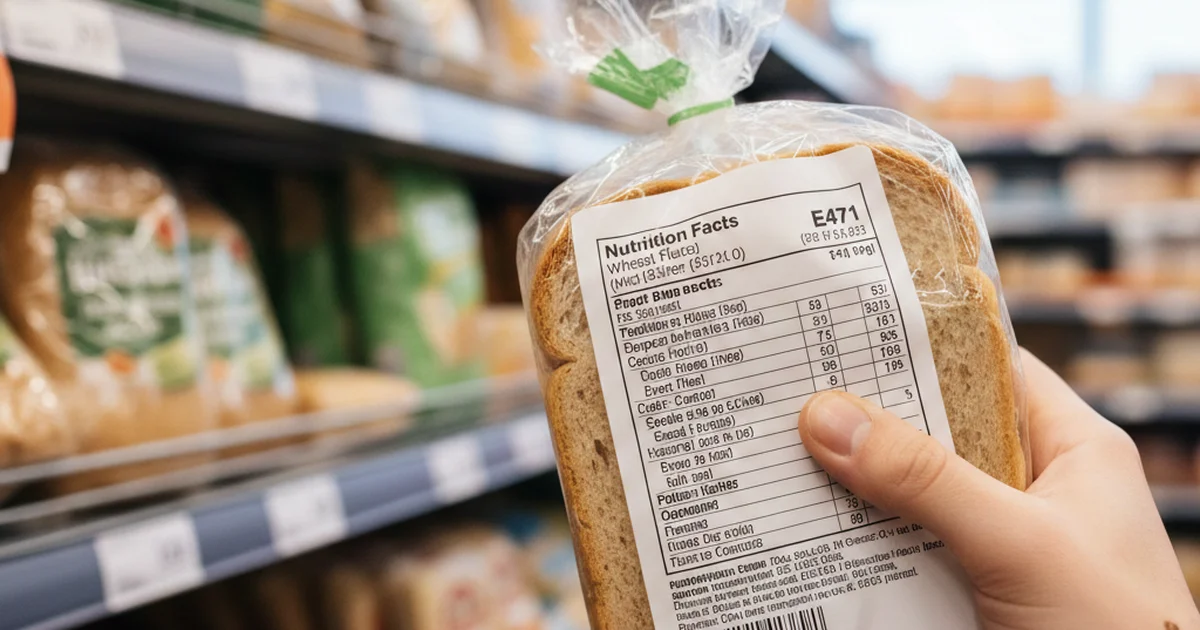
You spot E471 on a label. Should you buy it or put it back?
That pause you feel isn’t overthinking - it’s the right instinct. E471 is one of the most common additives in bread, ice cream, cakes, and chocolate. It’s also one of the trickiest for Muslim shoppers because the same code can be halal in one product and haram in another.
The short answer: E471’s halal status depends entirely on its fat source. This guide gives you a practical system to handle it - without turning every grocery trip into a research project.
What Is E471?
E471 stands for mono and diglycerides of fatty acids. It is an emulsifier, which means it helps ingredients like oil and water stay mixed.
You will often find it in:
- Bread and buns
- Cakes and pastries
- Ice cream and frozen desserts
- Chocolate spreads and confectionery
- Margarine and creamy sauces
If you want the full E-code context first, start with our E-Codes Halal Guide.
Why E471 Is Sometimes Halal and Sometimes Not
E471 can be made from different fat sources:
- Plant oils
- Animal fats (including beef)
- Animal fats (including pork)
From an Islamic dietary perspective, that changes everything.
| Source | Typical Ruling | Notes |
|---|---|---|
| Plant-based fats | Usually halal | Most straightforward case |
| Beef fat (zabiha) | Halal | Requires slaughter compliance |
| Beef fat (non-zabiha) | Not halal for many Muslims | Depends on your fiqh position |
| Pork fat | Haram | Not permissible |
That is why two products can both list E471, but only one is acceptable for you.
Is E471 Haram by Default?
Not always. But if the source isn’t clear, most Muslims choose caution - and that’s a reasonable approach.
A realistic decision framework:
- Prefer halal-certified products - source has already been verified
- Check if the manufacturer confirms plant source - a quick email or website check
- If neither is available, choose an alternative - plenty of products avoid E471 entirely
For an instant lookup, search E471 in our E-codes database.
How to Verify E471 in Real Shopping Situations
1. Look for halal certification first
This is the fastest path. A credible halal mark usually means source verification has already happened.
2. Scan ingredient labels quickly
Use Verify Ingredients to scan and check additive status while you shop.
3. Contact brands when needed
A short message works:
“Can you confirm whether E471 in this product is plant-derived or animal-derived?“
4. Save your trusted products
Once you verify a product, keep a personal safe list. This removes repeated decision fatigue.
Common Confusions About E471
”It says vegetarian, so it must be halal.”
Not always. “Vegetarian” helps, but labeling standards differ by country. A product can be vegetarian and still contain E471 from animal fat.
”If it’s in a major supermarket, it should be fine.”
Store quality has nothing to do with halal source transparency. Premium products use the same emulsifiers as budget ones.
”E-numbers are all synthetic anyway.”
Some are - but E471 specifically is one where the source varies. It can be plant-based, beef-based, or pork-based, and the label won’t tell you which.
Better Alternatives When E471 Is Unclear
If a product doesn’t clarify its E471 source, grab something safer:
- Halal-certified products - source already verified for you
- Brands that state “plant-based emulsifier” - transparent about sourcing
- Simpler products - shorter ingredient lists mean fewer unknowns (artisan bread with just flour, water, salt, yeast)
Dealing with similar uncertainty around gelatin? Read Gelatin: Halal or Haram? - same verification approach, different ingredient.
Quick FAQ
Is E471 always haram?
No. E471 isn’t automatically haram - it depends entirely on the fat source used in manufacturing. Plant-based E471 is halal. Pork-based is haram. Beef-based depends on slaughter method.
Is plant-based E471 halal?
Yes. Plant-derived E471 is widely accepted as halal by scholars and certification bodies.
Should I avoid E471 completely?
That depends on your comfort level. Many Muslims avoid it when the source is unclear and consume it when it’s verified as plant-based or halal-certified. A quick check removes the guesswork.
Where can I check E471 fast while shopping?
Scan the product label for instant results, or search E471 directly in the E-codes database.
What To Do Next
E471 isn’t a “yes or no” additive - it’s a verify first additive.
Here’s your system going forward:
- Check E471 instantly - see source details and halal ruling
- Scan any product label - get E471 status along with every other additive in seconds
- Build your safe list - once you verify a brand’s E471 source, you won’t need to check it again
That small verification habit protects your food choices and removes the stress from shopping. When in doubt, check first - then decide with confidence.
Related Articles
 How-To Guides
 How to Scan Food Labels with HalalCodeCheck
Step-by-step guide to scanning ingredient labels for halal verification. Tips for lighting, positioning, and getting accurate results every time.
 How-To Guides
 How to Use Voice Search to Check E-Codes
A step-by-step guide to using voice search on HalalCodeCheck. Say one E-code or several at once and get instant halal status without typing.
 How-To Guides
 Understanding Halal, Mushbooh, and Haraam Status
What do Halal, Mushbooh, and Haraam mean for food additives? A clear guide to interpreting E-code statuses and making confident decisions while shopping.
Ready to verify E-codes instantly?
Stop guessing about food ingredients. Use HalalCodeCheck to scan products and get instant halal verification.