
When you scan a product or look up an E-code, you get one of three statuses: Halal, Mushbooh, or Haraam. Most people understand the first and the last. Mushbooh is where the questions start.
This guide explains exactly what each status means, why the same additive can legitimately get different verdicts from different sources, and how to make a confident decision when you’re standing in the aisle.
The three statuses explained
Halal ✓
The additive is permissible under Islamic dietary law. This applies when:
- The substance itself is inherently permissible (e.g. E300 - Ascorbic Acid, which is vitamin C)
- The substance is derived from halal sources only
- There is no meaningful risk of contamination from haram sources
What to do: No concern. The additive is fine to consume.
Common examples: E100 (Curcumin), E300 (Ascorbic Acid), E330 (Citric Acid), E322 when from soy or sunflower (Lecithin).
Mushbooh ⚠ (Doubtful / Questionable)
Mushbooh comes from the Arabic word for “doubtful.” An additive gets this status when:
- It can be halal or haram depending on its source
- The source is not declared on the label
- There is genuine scholarly disagreement about its permissibility
Mushbooh does not mean the product is haram. It means you cannot confirm it is halal without knowing where the additive came from.
What to do: Check the source details on the individual code page. Contact the manufacturer if the source matters to you, or choose a product with halal certification if you want certainty.
The most common Mushbooh additive is E471 - Mono and Diglycerides of Fatty Acids. It can come from plant oils (halal) or animal fats (potentially haram). Without declaration, the source is unknown.
Haraam ✗
The additive is not permissible under Islamic dietary law. This applies when:
- The substance is derived from a haram source (e.g. pork-derived gelatin)
- The substance itself is prohibited (e.g. alcohol used as a carrier)
- The most common production method involves haram inputs with no halal alternative widely available
What to do: Avoid the product. Look for an alternative in the same food category, or choose a product with halal certification.
Common examples: E120 - Cochineal/Carmine (derived from insects), E441 - Gelatin when pork-derived.
Why the same code can have different verdicts
You may have seen different sources give different statuses for the same additive - especially for Mushbooh codes. This comes down to two things:
1. Source variation
Many additives can be produced from multiple raw materials. E471, for example, is commercially produced from both vegetable oils and animal fats. The manufacturer chooses based on cost and availability - and the label doesn’t have to disclose which one they used.
HalalCodeCheck marks these as Mushbooh because we cannot determine the source from the label alone. Other sources may mark the same code as Halal (assuming plant source) or Haram (assuming animal source). Neither is necessarily wrong - they’re making different assumptions about the same uncertainty.
2. Madhab differences
The four main madhabs (Hanafi, Maliki, Shafi’i, Hanbali) apply different principles to edge cases. A few examples:
- Gelatin from non-zabiha beef: some madhabs consider the transformation (istihalah) sufficient to make it permissible; others do not
- Carmine (E120): some scholars prohibit all insect-derived ingredients; others permit it based on transformation
- Alcohol in flavorings: there is significant variation in the threshold that constitutes harm vs incidental presence
Where there is a meaningful difference between madhabs, you’ll see a Madhab Notes section on the individual E-code page.
How to read a result on HalalCodeCheck
When you scan a label or search a code, the result shows:
- Overall status - determined by the worst-case code in the list (one Haraam code makes the overall result Haraam)
- Count breakdown - how many Halal, Mushbooh, and Haraam codes were found
- Individual code cards - each with its own status, role, source, and any madhab notes
The overall status is conservative by design
If a scan finds 8 halal codes and 1 Mushbooh code, the overall result shows Mushbooh - not Halal. This is intentional. We surface the concern so you can decide, rather than burying it in a green result.
Decision framework for each status
If the result is Halal
No action needed. All additives checked are permissible.
If the result is Mushbooh
- Check which code(s) are Mushbooh - tap each one to see the source concern
- Read the source details - is it animal-derived, or just unknown?
- Check for certification - does the product carry a recognized halal mark? That overrides the uncertainty
- Consider your madhab - some Mushbooh codes are only a concern for specific schools of thought
- When in doubt, leave it out - if you can’t verify and there’s an alternative, choose the alternative
If the result is Haraam
The product contains at least one confirmed haram additive. Unless the manufacturer has halal certification that specifically addresses that additive (which would be unusual), avoid the product.
Check the food category page for the product type - you may find similar products that are clean.
Codes that are often misunderstood
E322 - Lecithin
Usually soy or sunflower-derived (Halal). Sometimes egg-derived (Halal). Very rarely animal-derived. When the source is unspecified, we mark it Mushbooh. If the label says “soya lecithin” or “sunflower lecithin”, it’s Halal.
E471 - Mono and Diglycerides of Fatty Acids
The most commonly questioned additive in packaged food. Plant-sourced: Halal. Animal-sourced without zabihah slaughter: Haram. Source undeclared: Mushbooh. Full guide: Is E471 Halal? Complete Guide.
E441 - Gelatin
Almost always Haraam in non-halal-certified products because the default commercial source is pork. Beef gelatin from non-zabiha slaughter is Mushbooh. Halal-certified fish or beef gelatin is Halal. Full guide: Gelatin - Halal or Haram?.
E120 - Cochineal / Carmine
Derived from insects. Classified as Haraam by the majority of contemporary scholars. Some Maliki scholars permit it. If you follow a madhab that permits insect-derived substances, you may treat this differently - check the Madhab Notes on the E120 code page.
A note on Unknown status
Occasionally you’ll see Unknown on a code. This means the additive is in our database but we don’t have enough sourcing information to assign a definitive status. Treat Unknown the same way as Mushbooh - seek confirmation before consuming if it matters to you.
What to do next
- Look up a specific code: E-codes database →
- Browse by food type to find categories with known Mushbooh or Haraam additives: Food categories →
- See common additives by food: 10 foods you thought were halal but aren’t
Now that you know what each status means, put it into practice. Scan any ingredient label and see the statuses in context.
Related Articles
 How-To Guides
 How to Scan Food Labels with HalalCodeCheck
Step-by-step guide to scanning ingredient labels for halal verification. Tips for lighting, positioning, and getting accurate results every time.
 How-To Guides
 How to Use Voice Search to Check E-Codes
A step-by-step guide to using voice search on HalalCodeCheck. Say one E-code or several at once and get instant halal status without typing.
 Ingredients
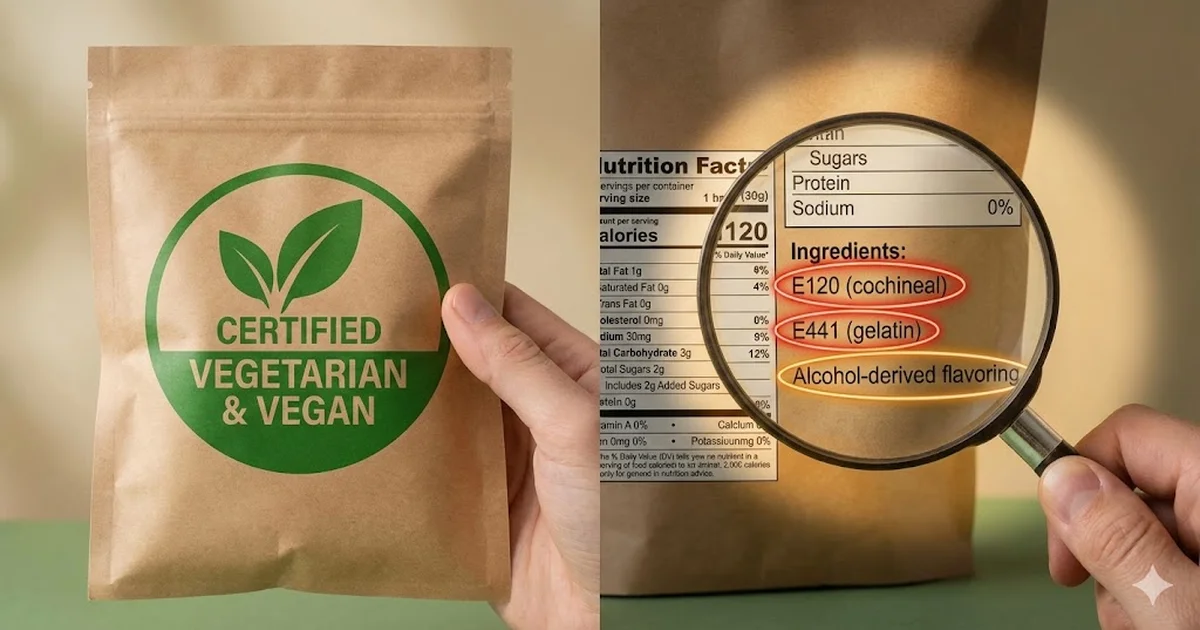
 Why 'Vegetarian' Does Not Always Mean Halal
Many Muslim shoppers assume vegetarian products are automatically halal. Learn where that assumption fails and what to check before buying.
Ready to verify E-codes instantly?
Stop guessing about food ingredients. Use HalalCodeCheck to scan products and get instant halal verification.